


KCET stands for Karnataka Common Entrance Test, also known as UGCET, a state-level entrance exam conducted by the Karnataka Examinations Authority (KEA) for admission to undergraduate professional courses in Karnataka, engineering and technology, agriculture and farm science, pharmacy, veterinary science, and other eligible programmes. It’s based on the Class 11 and Class 12 PUC syllabus, held annually, and is a key step for Karnataka students aiming for these courses at government and participating private colleges.
For Karnataka students finishing PUC, KCET is usually the first entrance exam that actually decides where they’ll study next, not just how well they’ve understood two years of Physics, Chemistry and Maths or Biology. The KCET entrance exam, short for Karnataka Common Entrance Test and also referred to as UGCET, is conducted by the Karnataka Examinations Authority, KEA, and it’s the state-level gateway to undergraduate professional courses across Karnataka: engineering and technology, agriculture and farm science-related courses, pharmacy programmes, veterinary and other eligible professional courses, and nursing or allied programmes where applicable. For a Karnataka student, KCET matters because it directly affects admission to government-quota seats and many private college seats across these courses, often more directly than a national-level exam does for a specific state college. Getting a clear picture of eligibility, syllabus, exam pattern, paper pattern, dates, the application process and counselling, before diving into subject-wise preparation, saves a lot of confusion later. This article covers each of these in plain language, and connects PUC preparation directly to what KCET actually tests, since the two aren’t separate tracks for a Karnataka student; they’re the same syllabus serving two purposes at once.
What Is KCET Exam?
KCET, the Karnataka Common Entrance Test, is a state-level entrance examination conducted annually by the Karnataka Examinations Authority for admission to undergraduate professional courses in Karnataka. It’s based on the first and second PUC syllabus, which is exactly why strong PUC preparation and KCET preparation aren’t two separate efforts for a Karnataka student, they overlap almost entirely. KCET is sometimes referred to as UGCET (Undergraduate Common Entrance Test) in official and informal references, and both names point to the same examination.
Which Courses Can Students Get Through KCET?
KCET scores are used for admission to a range of professional undergraduate courses in Karnataka, most commonly:
- Engineering and Technology (B.E./B.Tech)
- Agriculture and farm science-related courses
- Pharmacy programmes (B.Pharm)
- Veterinary science and related programmes
- Other eligible professional courses, including nursing or allied health programmes where applicable
Certain courses, such as MBBS, BDS and B.Arch, have separate entrance requirements (NEET and NATA respectively) rather than being admitted purely on KCET scores, so it’s worth confirming which entrance exam actually applies to a specific course before assuming KCET covers it.
KCET Eligibility Criteria
Educational Qualification
Candidates generally need to have passed, or be appearing for, Class 12 (2nd PUC) or an equivalent examination from a recognised board.
Subject Requirements
For Engineering Aspirants: Physics, Chemistry and Mathematics as the required subject combination.
For Biology-Based Courses: Physics, Chemistry and Biology as the required subject combination, relevant for pharmacy, agriculture and related programmes.
Karnataka Eligibility / Study Requirements
Government-quota seats generally require the candidate to meet Karnataka domicile or study requirements set by KEA; candidates who have studied outside Karnataka for an extended period may not qualify for the government quota specifically, even if they remain eligible to appear for the exam itself. These rules can be detailed and vary by category, so checking the exact current requirement against the official KEA notification, rather than a general assumption, matters here more than in most other sections.
Important Documents
- Class 10 and Class 12 mark sheets
- A recent passport-size photograph
- A scanned signature
- A valid government-issued photo ID
- Category or domicile certificates, where applicable
Course-specific eligibility rules can differ in detail, so confirming the exact requirement for a specific course against the current KEA notification is worth doing before assuming general eligibility applies.
KCET Exam Date and Important Dates
KCET follows a broadly consistent annual timeline, though exact dates are set fresh each year by KEA. As a concrete reference point, the table below shows the actual 2027 cycle:
| Event | 2027 Cycle (expected, unconfirmed) |
| Application begins | Mid-to-late January 2027 |
| Application last date | Late February 2027 |
| KCET examination | Third or fourth week of April 2027 |
| Result | Late May / Early June |
| Counselling | Conducted in multiple rounds through mid-2027 |
These 2027 dates are indicative projections based on past cycles, not confirmed dates, and should be treated as a planning guide rather than a fixed schedule. The only reliable source for the exact 2027 dates is the official KEA notification on cetonline.karnataka.gov.in — checking there directly before making any preparation or application decisions is worth the extra few minutes.
KCET Syllabus
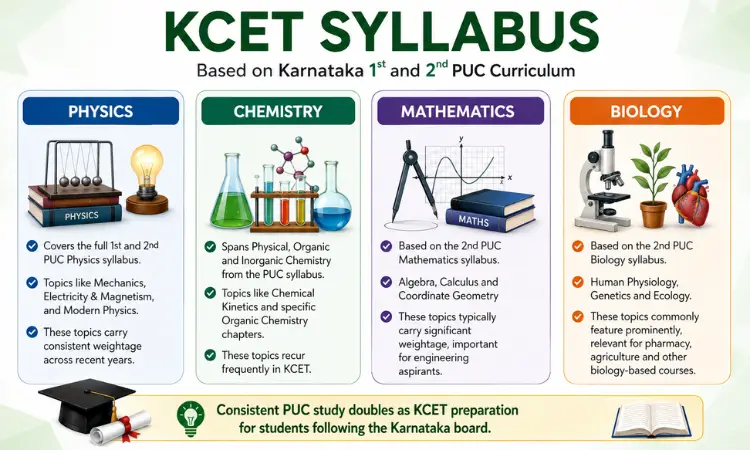
KCET’s syllabus is drawn from the Karnataka 1st and 2nd PUC curriculum, which is exactly why consistent PUC study doubles as KCET preparation for students following the Karnataka board.
Physics
Covers the full 1st and 2nd PUC Physics syllabus, with topics like mechanics, electricity and magnetism, and modern physics carrying consistent weightage across recent years.
Chemistry
Spans Physical, Organic and Inorganic Chemistry from the PUC syllabus, with topics like chemical kinetics and specific organic chemistry chapters recurring frequently.
Mathematics
Based on the 2nd PUC Mathematics syllabus, with Algebra, Calculus and Coordinate Geometry typically carrying significant weightage, relevant for engineering aspirants.
Biology
Based on the 2nd PUC Biology syllabus, with Human Physiology, Genetics and Ecology commonly featuring prominently, relevant for pharmacy, agriculture and other biology-based courses.
KCET Exam Pattern and KCET Paper Pattern
Subjects
KCET is conducted as separate papers for Physics, Chemistry, and Mathematics or Biology, depending on the course track a student is aiming for. Engineering aspirants typically sit Physics, Chemistry and Mathematics; pharmacy, agriculture and related course aspirants typically sit Physics, Chemistry and Biology.
Question Format
Each paper consists of multiple-choice questions with four options each, answered on an OMR sheet in offline, pen-and-paper mode.
Duration
Each subject paper runs for 80 minutes (1 hour 20 minutes), with Physics and Chemistry typically held on one day and Mathematics and Biology on the other.
Marking Scheme
One mark is awarded for each correct answer, and there is no negative marking for incorrect answers, which means attempting every question carries no direct penalty beyond the time spent.
Language
KCET question papers are available in English and Kannada. A separate Kannada Language Test applies specifically to candidates claiming eligibility under the Horanadu or Gadinadu Kannadiga categories for government quota seats; it isn’t a requirement for the general candidate pool.
| Subject | Questions | Marks | Duration |
| Physics | 60 | 60 | 80 minutes |
| Chemistry | 60 | 60 | 80 minutes |
| Mathematics / Biology | 60 | 60 | 80 minutes |
This pattern, three papers, 60 questions and 60 marks each, 180 marks in total, has held consistently in recent years, though students should confirm the current year’s pattern against the official KEA information bulletin rather than assuming it will never change.
How to Apply for KCET?
- Visit the official KEA website (cetonline.karnataka.gov.in)
- Register using the required personal details
- Enter personal and academic information
- Select the relevant course and subject combination
- Upload the required documents and photograph
- Pay the applicable application fee
- Carefully review the application before submitting
- Submit the application
- Save or download the confirmation and application page
How to Prepare for KCET?
Follow the PUC Syllabus
Since KCET draws directly from the PUC curriculum, thorough, concept-based PUC study is the foundation of KCET preparation, not a separate activity from it.
Create a Daily Study Timetable
A consistent daily routine that allocates time across all three subjects tends to work better than cramming one subject at a time in isolation.
Practise Previous Question Papers
Working through past KCET papers builds familiarity with question style and helps identify which topics come up repeatedly.
Take KCET Mock Tests
Timed mock tests under exam-like conditions build the speed and accuracy the 80-minute-per-paper format actually demands.
Balance Board Exams and KCET
Since KCET and PUC board exams draw from the same syllabus, a well-structured routine can prepare for both together rather than treating them as competing priorities for study time.
Why Choosing the Right PU College Matters for KCET Preparation
When families search for the best PU colleges in Mangalore, or simply good colleges in Mangalore for their child’s PUC years, a big part of what actually matters is whether the college treats KCET preparation as part of the regular academic routine, rather than something students figure out separately after class hours. This can look like regular problem-solving practice woven into subject teaching, periodic mock tests, and doubt-clearing sessions timed around the KCET syllabus rather than only the board exam calendar. No PU college can guarantee a specific KCET rank or admission outcome, that depends on the student’s own preparation and performance, but a college’s academic structure and support can meaningfully shape how organised that preparation ends up being. Students evaluating PU colleges for this reason should look at how a college’s academic year is actually structured around competitive exam timelines, not just its board exam results.
KCET Counselling and Admission Process
After KCET results are announced, eligible candidates go through a counselling process conducted by KEA, typically involving document verification, entering college and course preferences (option entry), and seat allotment across multiple rounds. Each round generally requires candidates to confirm or exercise their allotted seat within a set window, and specific rules around round-wise allotment, upgrades and reporting can vary by year. Following the official KEA counselling schedule closely, rather than relying on a general understanding from a previous year, matters here since missing a specific window can affect seat allotment.
Conclusion
KCET, the Karnataka Common Entrance Test, is the state-level gateway to undergraduate professional courses in Karnataka, engineering, pharmacy, agriculture, veterinary science and related programmes, conducted annually by the Karnataka Examinations Authority. For Karnataka students, understanding four things clearly matters most: the eligibility criteria for the specific course being targeted, the PUC-based syllabus, the exam and paper pattern, and the exam date and application timeline for the current year. Starting preparation early, and building it around consistency, regular revision, mock tests and previous question papers, alongside genuine PUC coursework rather than separate from it, puts students in a considerably stronger position than starting late. Since dates, eligibility details and pattern specifics can be updated by KEA from year to year, verifying the latest official KCET notification before applying is a step worth taking seriously rather than skipping. Choosing a PU college that supports this kind of structured preparation alongside solid academics can make the two years leading up to KCET considerably more manageable. For Karnataka students working through this stage of their education, steady, consistent effort over these two years counts for more than any single week of last-minute preparation.
Looking for a PU college in Mangalore with structured KCET preparation built into the academic year? Learn more about Vibrant Moodubidire’s PUC programmes.
Frequently Asked Questions
1. What is the difference between KCET and JEE Main?
KCET is a Karnataka state-level exam for admission mainly to colleges within Karnataka, based on the PUC syllabus, while JEE Main is a national-level exam used for admission to NITs, IIITs and other centrally-funded institutions across India, based on the CBSE-aligned syllabus. Many Karnataka students appear for both, since the syllabus overlap is substantial.
2. What is the difference between KCET and NEET?
KCET covers a range of courses including engineering, pharmacy and agriculture, while NEET is specifically the entrance exam for medical courses like MBBS and BDS across India. A student aiming for a medical seat needs to appear for NEET, not KCET, for that specific course.
3. Is there negative marking in KCET?
No. KCET awards one mark for each correct answer and does not deduct marks for incorrect answers, so there’s no penalty for attempting a question you’re unsure about.
4. Can a student from outside Karnataka appear for KCET?
Students can generally appear for KCET, but eligibility for Karnataka’s government-quota seats specifically depends on domicile and study-history requirements set by KEA, which can be detailed and vary by category. Checking the current official eligibility criteria is important before assuming government-quota eligibility.
5. Where can I find the official KCET notification and updates?
The Karnataka Examinations Authority publishes official KCET notifications, schedules and updates on cetonline.karnataka.gov.in, which is the most reliable source for current dates, eligibility criteria and pattern details.
About the Author
Rachana S is an SEO Executive at OneCity Technologies, Bangalore, with experience in content strategy and digital marketing across education and professional services verticals. LinkedIn: linkedin.com/in/rachana-s-341a04352
Reviewed by L K Monu Borkala, a digital marketing strategist with 20+ years of SEO experience and 650+ client campaigns across India and UAE, overseeing content strategy and editorial compliance at OneCity Technologies. LinkedIn: linkedin.com/in/monuborkala