


NEET negative marking deducts 1 mark for every incorrect answer while awarding 4 marks for each correct response. With 180 questions worth 720 marks, even 10 wrong answers cost 40 potential marks: 10 lost to penalties plus 30 missed from correct answers. Understanding this system helps students decide when to attempt a question and when to skip.
NEET UG awards 4 marks for every correct answer and deducts 1 mark for every wrong one. That 5-mark difference between answering a question correctly and incorrectly makes accuracy more valuable than speed during the three-hour examination. The National Testing Agency designed this NEET negative marking system specifically to discourage random guessing and reward students who answer with genuine understanding. For PCMB students in Moodbidri and across Karnataka preparing through their PUC years, knowing exactly how minus marking in NEET works is the starting point of a scoring strategy that protects hard-earned marks.
What Is NEET Negative Marking and How Does the Marking System Work?
Negative marking is a scoring rule applied in NEET UG where the examination deducts marks from a student’s total for every incorrect answer. The purpose is simple: it penalises guessing so that only students with genuine subject knowledge and exam strategy earn higher scores.
The NEET UG examination paper contains 200 questions across four subjects: Physics, Chemistry, Botany, and Zoology. Each subject has two sections. Section A contains 35 mandatory questions. Section B contains 15 questions, of which students must attempt any 10. This structure means students attempt a total of 180 questions from the paper, with a maximum possible score of 720 marks.
The marking rules are defined in the NTA Information Bulletin released before each examination cycle:
| Answer Type | Marks Awarded or Deducted |
| Correct answer | +4 marks |
| Incorrect answer | -1 mark (deducted) |
| Unanswered question | 0 marks (no penalty) |
| More than one option marked | -1 mark (treated as incorrect) |
The key detail most students overlook: the cost of a wrong answer is not just 1 mark. It is effectively 5 marks, because you lose the 4 marks you would have gained from a correct answer plus the 1-mark penalty. This is why skipping an uncertain question is often the smarter move.
How to Calculate Your NEET Score with Negative Marking
The formula for calculating your NEET score after negative marking is:
NEET Score = (Number of Correct Answers x 4) – (Number of Incorrect Answers x 1)
Unanswered questions contribute 0 marks and do not affect the calculation. Students can use this formula as a simple NEET negative marking calculator after completing any mock test or practice paper.
1. Worked Example from the Brief
A student answers 120 questions correctly, 20 incorrectly, and leaves 40 unanswered:
• Correct: 120 x 4 = 480 marks
• Incorrect: 20 x 1 = 20 marks deducted
• Unanswered: 0 marks
Final Score = 480 – 20 = 460 out of 720
2. High-Accuracy Example
A student answers 150 correctly, 15 incorrectly, and leaves 15 unanswered:
• Correct: 150 x 4 = 600
• Incorrect: 15 x 1 = 15 deducted
Final Score = 600 – 15 = 585 out of 720
3. Why Accuracy Beats Volume
The comparison below shows how two students with the same number of correct answers can score very differently based on accuracy:
| Scenario | Correct | Incorrect | Unanswered | Score |
| High accuracy, many attempts | 150 | 15 | 15 | 585 |
| Moderate accuracy | 130 | 30 | 20 | 490 |
| Low accuracy, most attempted | 120 | 50 | 10 | 430 |
| Fewer attempts, high accuracy | 120 | 5 | 55 | 475 |
Compare Scenarios 3 and 4: both students answered 120 questions correctly. The student who attempted fewer questions but maintained higher accuracy scored 475, while the student who attempted nearly everything scored only 430. Forty-five additional wrong answers cost 45 marks in penalties, turning the same knowledge base into a significantly lower score.
Subject-Wise Impact of Negative Marking in NEET
Negative marking does not hit all three subjects equally. Each subject has characteristic error patterns that students can identify and address during NEET exam preparation.
1. Physics
Physics carries the highest risk of negative marking for most NEET aspirants. Numerical problems involving formulas, unit conversions, and multi-step calculations create more opportunities for errors than conceptual questions. A sign error in a force calculation or a unit mismatch in a thermodynamics problem costs 5 marks (4 lost + 1 penalty). Students who build a structured physics preparation plan focused on NCERT problems and previous-year papers develop the accuracy needed to reduce these errors.
2. Chemistry
Chemistry errors split between organic reaction mechanisms and numerical calculations in physical chemistry. Students frequently confuse similar reagents, miss intermediate steps in named reactions, or make errors in molarity and stoichiometry calculations. Inorganic chemistry questions testing specific properties of elements and compounds also catch students who rely on partial memorisation. Thorough NCERT revision, especially for inorganic chemistry tables and organic reaction pathways, reduces guessing in these sections.
3. Biology (Botany and Zoology)
Biology accounts for 360 of the 720 total marks, making it the highest-scoring section and also the section where negative marking causes the most absolute damage if accuracy drops. Common errors include confusing similar biological terms (mitosis vs meiosis stages, homologous vs analogous structures), mixing up classification details, and misreading questions that ask for the exception rather than the rule. Because biology is primarily conceptual rather than numerical, the solution is careful reading and line-by-line NCERT revision rather than formula practice. Biology questions also test application of concepts to unfamiliar scenarios, so students who memorise facts without understanding the underlying processes lose marks when the question is phrased differently from the textbook.
How Negative Marking Affects Your NEET Rank and Common Scoring Mistakes
NEET ranks are determined by total marks, with tie-breaking rules applied for students with identical scores. A difference of just 5 to 10 marks can shift a student’s rank by several hundred positions in the merit list, potentially changing the college and course available during counselling. Negative marking amplifies this: 5 careless errors cost 25 marks (5 penalties plus 20 missed correct marks), which can drop a student from a government medical college seat to a private college fee bracket.
The most common mistakes that lead to unnecessary mark losses include guessing answers without eliminating any options, rushing through the last 15 to 20 minutes of the paper, misreading questions that ask for the “incorrect” or “exception” option, and marking answers in the wrong row on the OMR sheet. Vibrant PU College has published a detailed guide on common mistakes PU students make during NEET preparation that covers these patterns in depth.
One particularly costly habit: changing a correct answer to an incorrect one during review. Research on examination behaviour consistently shows that a student’s first instinct is correct more often than not. Unless you find a clear reason to change your answer, such as noticing a calculation error or recalling a specific fact, leave the original response in place.
Strategies to Reduce Negative Marking in NEET
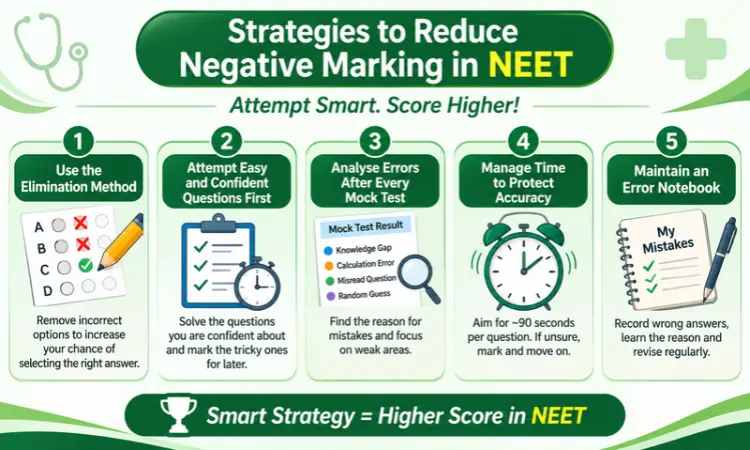
Reducing negative marking is not about attempting fewer questions. It is about attempting the right questions with higher confidence.
1. Use the Elimination Method
Before selecting an answer, eliminate the options you know are incorrect. If you can confidently rule out 2 of the 4 options, the probability of choosing correctly from the remaining two rises to 50 percent. At that probability, the expected value of attempting the question is positive: (0.5 x 4) – (0.5 x 1) = +1.5 marks. If you cannot eliminate even one option, skip the question.
2. Attempt Easy and Confident Questions First
Go through the entire paper in the first pass, answering only the questions you can solve with full confidence. Mark uncertain questions and return to them in the second pass. This approach ensures you collect maximum marks from your strongest topics before spending time on risky questions.
3. Analyse Errors After Every Mock Test
After each mock test, categorise every incorrect answer: was it a knowledge gap, a calculation error, a misread question, or a random guess? This analysis reveals the pattern behind your negative marks and tells you exactly where to focus revision. Vibrant PU College’s approach to practice tests in NEET preparation builds this analysis into the weekly cycle.
4. Manage Time to Protect Accuracy
With 180 questions in 180 minutes, students have roughly 1 minute per question. Spending 3 to 4 minutes on a difficult question often leads to a rushed final section where errors multiply. Set a mental time limit of 90 seconds per question. If you have not solved it by then, mark it and move on. For a detailed breakdown of pacing strategy, see Vibrant PU College’s guide to finishing the NEET paper in 180 minutes.
5. Maintain an Error Notebook
Keep a dedicated notebook where you record every incorrect answer from mock tests and practice papers, along with the correct answer and the reason you got it wrong. Review this notebook before each subsequent test. Over weeks of practice, you will notice the same error types recurring, and focused revision on those specific topics reduces repeat mistakes.
NEET Exam Preparation at Vibrant PU College, Moodbidri
Vibrant PU College in Moodbidri runs the Vistaara programme, a 2-year NEET classroom-integrated course that combines PUC board preparation with competitive exam coaching under one timetable. The programme covers Physics, Chemistry, Botany, and Zoology through the PCMB combination, with dedicated faculty for each subject. Regular mock tests follow the actual NEET pattern, including the negative marking rules described above, so students build accuracy under real examination conditions. For students beginning their NEET preparation journey, the integrated approach means daily revision, guided study sessions, and error analysis happen within the college schedule rather than requiring separate coaching.
Post-test analysis sessions at Vibrant identify each student’s negative-marking patterns by subject and question type, turning the data from every mock test into a targeted revision plan. This cycle of test, analyse, and revise is what converts understanding of the NEET negative marking system from theory into actual score improvement.
Contact Vibrant PU College:
• Phone: +91 7411417028
• Email: info@vibrantpucollege.com
• Location: Kallabettu, Moodbidri, Mangalore, Karnataka
Every mark on the NEET scorecard is the result of a decision: attempt, skip, or guess. The marking scheme rewards students who make that decision deliberately. Understanding exactly how NEET negative marking works, practising score calculations after every mock test, and building subject-specific accuracy through consistent revision are the three steps that turn the penalty system from a threat into a strategic advantage. Students who prepare with this discipline, whether independently or through structured coaching, give themselves the strongest possible position on examination day.
Explore Admissions Start your NEET preparation with structured coaching at Vibrant PU College, Moodbidri. Contact +91 7411417028 or visit vibrantmoodubidire.com for admission details.
Frequently Asked Questions
What is NEET negative marking?
NEET negative marking is a scoring rule where 1 mark is deducted for every incorrect answer. Correct answers earn 4 marks, and unanswered questions receive 0 marks. This rule applies across all sections of the NEET UG examination as defined by the National Testing Agency.
How many marks are deducted for a wrong answer in NEET?
One mark is deducted for every incorrect answer in NEET. Since a correct answer earns 4 marks, the net difference between answering correctly and incorrectly is 5 marks per question.
How do you calculate your NEET score with negative marking?
Use the formula: NEET Score = (Number of Correct Answers x 4) minus (Number of Incorrect Answers x 1). Unanswered questions do not affect the score. For example, 130 correct and 20 incorrect answers give (130 x 4) minus (20 x 1) = 500 marks out of 720.
Should you guess answers in NEET if you are unsure?
Random guessing is not recommended in NEET because each wrong answer costs 1 mark. If you can confidently eliminate 2 or more options, attempting the question improves your expected score. If you cannot eliminate any option, leaving the question blank avoids the penalty.
What is the total marks and total questions in NEET UG?
NEET UG has 200 questions across Physics, Chemistry, Botany, and Zoology. Students attempt 180 questions, with 35 mandatory and 10 of 15 optional per subject section. The maximum possible score is 720 marks.
About the Author
Written by Subhash Jha, CEO, Vibrant Academy for Innovative Learning, Moodbidri
Subhash Jha is the CEO of Vibrant Academy for Innovative Learning (VAIL), which runs Vibrant PU College in Moodbidri. He leads the institution’s integrated PUC and NEET/JEE preparation programme, working with the academic team on curriculum structure, guided study sessions and student academic support.
Reviewed by L K Monu Borkala, Chief Strategist, OneCity Technologies