


The best revision techniques for PUC science students are active recall, spaced repetition, short chapter notes, timed question papers and mock tests, with every mistake logged and re-solved. Match the method to the subject: formula and numerical practice for Physics and Mathematics, reaction charts for Chemistry, labelled diagrams and mind maps for Biology.
A student finishes Electrochemistry on Sunday, follows every step, and by the next Saturday cannot write the Nernst equation. That is ordinary forgetting, not weak ability, and PUC science makes it worse by packing four heavy subjects into one timetable. Revision is the repair. This guide sets out the best revision techniques for PUC science students, adapts them to each subject and shows how the same habits serve the board paper and entrance exams such as NEET, JEE and KCET.
Explore Vibrant Moodubidire for details of its educational programmes and student support.
Why Is Revision Important for PUC Science Students?
Understanding a chapter once does not keep it. Revision holds what you learned, exposes what you only thought you knew and finds weak topics while there is still time to repair them. It also builds the confidence to attempt a full paper.
PUC science adds a load problem. Physics and Mathematics reward problem practice. Chemistry mixes calculations, reactions and plain facts. Biology demands exact terms and neat diagrams. Four subjects, four kinds of memory, one timetable; a single habit such as rereading the textbook cannot serve all of them.
The research points the same way. In a 2013 review in Psychological Science in the Public Interest, Dunlosky and colleagues compared ten learning techniques that students commonly use. Practice testing and distributed practice earned the highest utility rating; rereading, highlighting and underlining, and summarisation were among five rated low. Karpicke and Roediger’s 2008 experiment in Science gave 40 students Swahili-English word pairs to learn. A week later, groups that kept testing themselves on every word recalled about 80% of the pairs; groups that stopped testing a word after one correct recall managed 36% and 33%.
Those were vocabulary pairs, not Physics, but the lesson carries over. Recognising a page is easier than producing its content, and an exam asks for production.
Revision techniques for exams work when they force the brain to retrieve information, repeat it on a schedule and end with feedback. Rereading and highlighting do none of the three.
| Technique | Rating in Dunlosky et al. (2013) | How to use it in PUC science |
| Practice testing: self-quizzing, past papers, mock tests | Highest utility | The core of every method below |
| Distributed practice: spaced revision | Highest utility | Revisit each chapter at widening gaps |
| Rereading | Low | Fine for the first pass; not a revision method |
| Highlighting and underlining | Low | Mark a line, then close the book and recall it |
| Summarisation | Low | Write short notes once, then use them as recall prompts, not reading matter |
The Best Revision Techniques for PUC Science Students
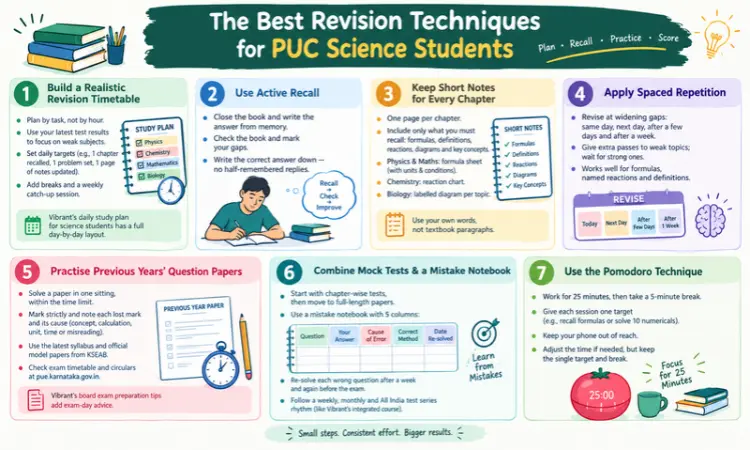
These seven methods work as a set. No single best method for revision exists. Good revision methods share one trait: each ends with a check against the correct answer.
1. How Do You Build a Realistic Revision Timetable?
Plan by task, not by hour. A study timetable for PUC students works when you rewrite it every week from the latest test results. A student whose last three tests show Chemistry as weakest might give it four of the next ten revision slots and the other subjects two each. Set daily targets you can finish: one chapter recalled from memory, one problem set, one page of notes updated. Add breaks and a weekly catch-up session. Vibrant’s daily study plan for science students has a full day-by-day layout.
2. How Does Active Recall Work?
Active recall means pulling an answer out of memory before you check it. Close the book and write the lens formula with its sign convention, the products of the Cannizzaro reaction, or the steps of DNA replication. Then open the book and mark every gap. Those gaps are your real syllabus for the evening. Write the answer down; a half-remembered one in your head feels finished.
3. Why Keep Short Notes for Every Chapter?
One page per chapter makes a full revision round possible in days instead of weeks. Put on it only what you must recall: formulas, definitions, reactions, diagrams and key concepts, in your own words. Physics and Mathematics need a formula sheet with units and conditions of use; Chemistry, a reaction chart; Biology, a labelled diagram per topic. Never copy textbook paragraphs. Notes are prompts for recall, which is how they avoid the low rating that summarisation received.
4. How Do You Use Spaced Repetition?
Spaced repetition means returning to a topic at widening gaps: the same day, the next day, after a few days and after a week. Material studied on Monday could be recalled again that night, on Tuesday, on Thursday and the following Monday. Treat the gaps as a starting pattern. A chapter you keep getting wrong earns extra passes; a secure one can wait. It suits anything you must hold for months, such as formulas, named reactions and definitions. Vibrant’s guide to 15 study tips for higher marks covers the wider habits around it.
5. How Should You Practise Previous Years’ Question Papers?
Solve a paper in one sitting, inside the time limit, before you look at the answers. Mark it strictly and write down each lost mark and its cause: concept, calculation, unit, time or misreading. Use the latest syllabus and the official model question papers of the Karnataka School Examination and Assessment Board; the Department of Pre-University Education publishes the exam timetable and circulars. Vibrant’s board exam preparation tips add exam-day advice.
6. How Do Mock Tests and a Mistake Notebook Work Together?
Start with chapter-wise tests and move to full-length papers as the syllabus closes. A mock test is only as useful as the analysis after it. Keep a mistake notebook with five columns: the question, your answer, the cause of the error, the correct method and the date you re-solved it. Re-solve each wrong question after a week and again before the exam. Vibrant’s integrated course lists weekly tests, monthly cumulative tests, unit-wise tests and an All India Test Series of full-length papers, a rhythm a self-study student can copy.
7. Can the Pomodoro Technique Keep You Focused?
Francesco Cirillo’s Pomodoro technique splits work into 25-minute sessions with a five-minute break. Give each session one target, such as recalling a chapter’s formulas or solving ten numericals, with the phone out of reach. Adjust the length if you need longer to settle into a numerical, but keep the single target and the break.
How Should You Revise Physics, Chemistry, Mathematics and Biology?
Each subject fails in its own way, so each needs its own drill.
| Subject | Where marks are usually lost | Revision method | Weekly drill |
| Physics | Wrong formula choice, missing units | Formula sheet with conditions of use | Re-solve every wrong numerical from the notebook |
| Mathematics | Slips in steps and arithmetic | Textbook examples first, then harder problems | One timed problem set per chapter |
| Chemistry | Forgotten reactions and exceptions, unit errors | Reaction charts and comparison tables | Redraw one chart from memory |
| Biology | Imprecise terms, wrong or unlabelled diagrams | Labelled diagrams and mind maps from memory | Draw and label three diagrams without the book |
How Do You Revise Numerical Problems in Physics and Mathematics?
Solving problems is the revision. A solved example teaches little until you can reproduce it. Revise each formula with its application: what it assumes, where it fails, what unit it returns. Work textbook examples before harder questions, write every step and check units and signs at the end, since a correct method with a wrong unit still loses marks. Re-solve the questions in your mistake notebook until you get them right twice. For entrance exams, add a timed MCQ set after each chapter.
How Do You Revise Chemistry With Tables and Reaction Charts?
Chemistry splits into three revision jobs. In Organic Chemistry, draw one chart linking compounds through reagents, so the Aldol condensation, the Cannizzaro reaction and the Sandmeyer reaction sit on one map. In Inorganic Chemistry, build comparison tables, for example across d-block elements. In Physical Chemistry, revise formulas with units and solve numericals, such as rate equations in Chemical Kinetics. Practise balanced equations and textbook questions within the prescribed syllabus.
How Do You Revise Biology With Mind Maps and Diagrams?
A mind map puts a heavy topic on one page: the central idea in the middle, branches for stages, structures and exceptions. Draw one for human reproduction, then draw its labelled diagrams from memory and check each label against the textbook. Use the textbook’s exact terms, since loose wording costs marks in Biology. Keep concise notes for definitions, classifications and processes such as DNA replication.
How Do You Balance PUC Board and Competitive Exam Revision?
The revision techniques for competitive exams match the board’s: recall, spacing and feedback. The answer format changes. A board paper asks for descriptive answers, derivations and step-by-step solutions; NEET, JEE and KCET ask for fast, accurate choices under time pressure. Textbook concepts feed both.
| Exam | Format and marking, as reported | What revision must add |
| Karnataka 2nd PUC (board) | Physics, Chemistry, Biology: 70 theory plus 30 practical or internal marks; Mathematics: 100 theory (Careers360 summary of the KSEAB blueprint) | Written answers, derivations, steps, diagrams and practicals |
| NEET UG | 180 questions, 720 marks, +4 and -1; Biology carries 90 questions (NTA pattern announced for the June 2026 exam) | Biology recall and speed, with care over guesses |
| JEE Main (Paper 1) | 75 questions, 300 marks, 3 hours, +4 and -1 (Careers360) | Multi-step numericals with accuracy |
| KCET | 60 questions per subject, one mark each, no negative marking (Careers360; KEA publishes the official pattern) | Attempt everything, quickly, in all subjects |
Patterns change, so confirm them in the current NTA or KEA bulletin. A balanced week keeps written, board-style practice for most days and adds one timed MCQ set per subject, shifting the mix toward whichever exam comes first. Vibrant’s course page describes Vistaara for PCMB students (NEET and CET) and Akanksha for PCMC students (JEE and CET), both built around the PUC syllabus. For exam-specific plans, read the guides to cracking NEET in the first attempt, JEE exam preparation and the KCET exam.
How Do You Find Weak Topics and Clear Doubts Early?
Start from evidence, not feeling. After each test, sort the chapters where you lost marks into three groups: concept not understood, concept understood but not practised, and careless errors. The first needs a teacher, the second needs problems, the third needs a checking routine. Keep the list visible and solve basic questions before advanced ones. Ask your teacher in the same week; a doubt left alone gets buried under new chapters. Vibrant’s About Us page describes doubt clarification sessions that teachers monitor, which helps students who hesitate to ask in class.
What Revision Mistakes Should PUC Science Students Avoid?
| Mistake | Practical fix |
| Rereading without testing memory | Close the book and write the answer first |
| Leaving revision to the last few days | Start a first revision round as each chapter ends |
| Avoiding difficult chapters | Give them the first slot of the day and extra spaced passes |
| Memorising formulas without practising their use | Attach one solved numerical to every formula |
| Skipping mock tests | Fix one test a week and protect that slot |
| Spending too long on decorative notes | One plain page per chapter; colour is optional |
| Sacrificing sleep for long study hours | Set a stop time; a tired mind recalls less |
What Does a Simple Revision Plan Look Like Before PUC Exams?
For 2nd PUC science exam preparation, work backwards from the exam date, then adjust for the weeks left and your current level.
1. Daily: recall earlier topics from memory, then solve questions on the day’s chapter.
2. Weekly: test the chapters completed, review the mistake notebook and set next week’s targets.
3. Final revision: key concepts, formulas, reactions, diagrams and weak areas only.
4. Before an exam: read the short notes, practise a few selected questions, then stop.
How Do You Review Progress Each Week?
Once a week, set completed chapters against pending ones, sit a practice test, review its mistakes and write next week’s targets. A chapter ticked off but not recalled is still pending; understanding counts for more than finishing.
Why Does a Healthy Routine Matter During Revision?
Sleep, regular meals, short breaks and some physical activity keep recall working. Leave the phone outside the study room, because distractions cut concentration. An all-night session trades tomorrow’s recall for tonight’s extra pages. A steady routine beats a heroic week.
Conclusion
Pick one habit and run it for seven days: close the book and recall a chapter before you reread it. Add spaced passes, a mistake notebook and a weekly test as it settles. Keep the timetable realistic, ask teachers for help early and balance board and entrance preparation. No technique promises a mark or a rank, but steady effort builds the confidence to walk into the exam hall knowing what you know.
Visit Vibrant Moodubidire to explore its educational programmes and academic support.
Frequently Asked Questions
What is the best method for revision?
No single method wins on its own. Active recall and spaced repetition have the strongest research support, since Dunlosky and colleagues rated practice testing and distributed practice highest. Combine them with timed question papers and a mistake notebook, and match the format to the subject.
How many hours should a PUC science student spend on revision each day?
Research gives no single number, so plan by tasks. A workable daily set is one chapter recalled from memory, one problem set and one page of short notes updated, with a test each week. The hours follow the tasks and grow as the exam gets closer.
How often should I revise a chapter I have already finished?
Revise it the same day, the next day, after a few days and after a week, then once every week or two until the exam. Chapters you keep getting wrong need extra passes. Chapters you can recall without effort can wait longer.
Are mock tests useful for the 2nd PUC board exam or only for NEET, JEE and KCET?
They help for both. For the board, chapter-wise tests and timed past papers train written answers and time management. Full-length mock tests matter more for NEET, JEE and KCET, where speed and accuracy under the clock decide the score.
What should I do the day before a PUC science exam?
Read your short notes, formula sheet, reaction charts and labelled diagrams. Solve a few selected questions from weak topics, pack what you need and sleep on time. Start no new chapter; the day is for recall, not for learning something unfamiliar.
General study guidance only. Exam patterns, syllabi and marking schemes change, so confirm them with the official board, NTA or KEA notices and your teachers. Individual results vary.
About the Author
• Subhash Jha is the CEO of Vibrant Academy for Innovative Learning (VAIL), which runs Vibrant PU College in Moodbidri. He leads the institution’s integrated PUC and NEET/JEE preparation programme, working with the academic team on curriculum structure, guided study sessions and student academic support.
• Reviewed by L K Monu Borkala, Chief Strategist, OneCity Technologies, a digital marketing strategist with 20+ years of SEO experience and over 650 client campaigns across India and UAE.