

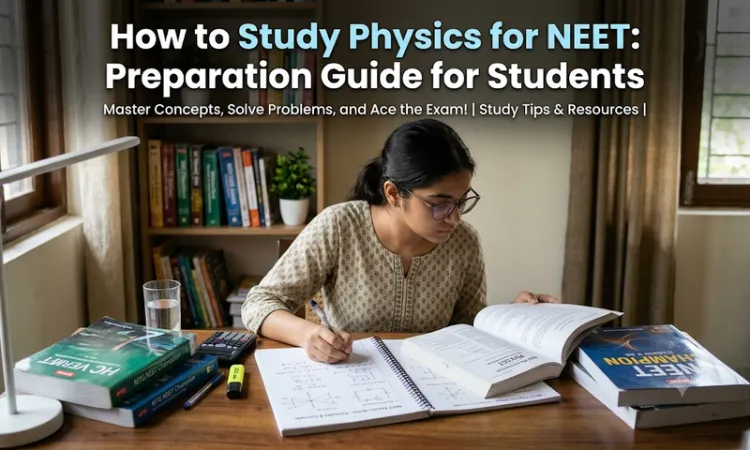
How to Study Physics for NEET: Preparation Guide for Students
Start with NCERT Class 11 and 12 textbooks, build concept clarity before memorising formulas, and practise numerical problems daily. Focus on high-weightage chapters such as Current Electricity, Ray Optics, Semiconductor Electronics and Electrostatic Potential, which together account for roughly 25% of the Physics section. Solve previous year NEET papers chapter-wise and take full-length mock tests under timed conditions.
Physics carries 180 of the 720 marks in NEET, yet it is the section most students find the hardest to score in. The syllabus spans 28 chapters across Class 11 and Class 12, from mechanics and thermodynamics to electrodynamics and modern physics, and every chapter can produce both conceptual and numerical questions.
Students who score well in NEET Physics do not study more hours; they study with a plan. A structured NEET physics preparation approach, built on concept clarity, daily problem practice and regular mock tests, turns a difficult subject into a reliable scoring section.
NEET Physics Syllabus and Chapter Weightage
The NEET Physics section has 45 multiple-choice questions. Section A carries 35 compulsory questions; Section B carries 15 questions, of which students attempt any 10. Each correct answer scores +4 marks; each incorrect answer deducts 1 mark. The total Physics score is 180 out of 720.
The syllabus draws from NCERT Class 11 and Class 12 textbooks and divides into five broad areas:
| Area | Key Class 11 Chapters | Key Class 12 Chapters |
| Mechanics | Laws of Motion, Work Energy and Power, Gravitation, Rotational Motion, Mechanical Properties of Solids and Fluids | Kinematics concepts feed into all areas |
| Thermodynamics | Thermodynamics, Kinetic Theory, Thermal Properties of Matter | (covered in Class 11) |
| Electrodynamics | (covered in Class 12) | Electric Charges and Fields, Electrostatic Potential, Current Electricity, Magnetism, Electromagnetic Induction, Alternating Current |
| Optics | (covered in Class 12) | Ray Optics and Optical Instruments, Wave Optics |
| Modern Physics | (covered in Class 12) | Dual Nature of Radiation, Atoms, Nuclei, Semiconductor Electronics |
Based on analysis of previous NEET papers from 2021 to 2025 (Careers360), these chapters consistently carry the highest weightage:
| Chapter | Approx. Weightage | Typical Questions |
| Current Electricity | 8% | 3 to 4 |
| Electrostatic Potential and Capacitance | 6% | 2 to 3 |
| Ray Optics and Optical Instruments | 6% | 2 to 3 |
| Semiconductor Electronics | 6% | 2 to 3 |
| Gravitation | 6% | 2 to 3 |
| Oscillations | 5% | 2 |
| Alternating Current | 5% | 2 |
| Laws of Motion | 3 to 4% | 1 to 2 |
NTA does not publish a fixed chapter-wise weightage, and any chapter can appear in the paper. These high-weightage chapters deserve extra practice and repeated revision, but students should not skip any chapter entirely. A full chapter-wise breakdown is available at Motion Education.
How to Study Physics for NEET: Build Concepts Before Formulas
Jumping straight to numerical problems without understanding the underlying physics is the single most common NEET physics preparation mistake. A sequence that works:
Read the NCERT chapter first. Not the coaching module, not a reference book: the NCERT textbook. NTA designs NEET questions from NCERT, and many questions are direct applications of NCERT examples or in-text exercises.
Understand the physical law, not just the formula. Knowing F = ma is useless if a student cannot identify which forces act on a body and in which direction. Draw free-body diagrams. Trace how current flows through a circuit before applying Kirchhoff’s laws.
Learn units and dimensions. Dimensional analysis eliminates wrong options in roughly one out of every five NEET Physics questions. If an answer’s dimensions do not match the expected quantity, it is wrong regardless of the calculation.
Build a formula notebook. Write each formula, what every symbol means, its SI unit, and one example where it applies. Revise this notebook daily for 15 minutes.
Connect formulas to each other. Energy conservation links mechanics to thermodynamics. Ohm’s law connects to Kirchhoff’s laws. Electromagnetic induction relies on magnetic flux concepts. Students who see these connections solve cross-topic problems faster.
Students who follow this sequence before attempting MCQs report fewer careless errors, because they understand why a formula applies in a given context rather than guessing which formula fits. This is the foundation of how to study physics for NEET: clarity first, speed later.
Creating a NEET Physics Study Plan
A NEET physics study plan that produces results has three components: daily practice, weekly revision and monthly testing. Here is a structure that balances Physics with Chemistry and Biology:
| Day | Physics Focus (2 hours) | Practice Task |
| Monday | New chapter: read NCERT, take notes | Solve 20 MCQs from the same chapter |
| Tuesday | Continue chapter: formulas and derivations | Solve 20 numericals, easy to difficult |
| Wednesday | Revision of last week’s chapter | 30-question timed chapter test (40 minutes) |
| Thursday | New chapter: read NCERT, take notes | Solve 20 MCQs from this chapter |
| Friday | Continue chapter: formulas and derivations | Solve 20 numericals |
| Saturday | Formula notebook revision, rework errors | 30-question chapter test from Thursday’s topic |
| Sunday | Full Physics revision: weak topics from the week | 45-question mock test (60 minutes) |
The daily Physics slot should be at a fixed time. Students who study Physics at random hours retain less than those who practise at a consistent time. Two focused hours with active problem-solving is more productive than four hours of passive reading.
Revision schedule: Completed chapters: revise once every week for the first month, then once every two weeks. Formula notebook: revise daily. Previous year papers: one full paper every two weeks starting from the third month of preparation.
Practice Strategy: Numericals, Previous Year Papers and NEET Physics Mock Tests
Knowing the theory gets a student to roughly 100 marks. Scoring 140 to 160 requires practice under exam conditions.
1. Daily Numerical Practice
Start with NCERT back-of-chapter problems. Move to H.C. Verma (Concepts of Physics) for conceptual numericals. Then use D.C. Pandey for NEET-pattern MCQs. The progression matters: skipping basic problems and jumping to coaching modules leaves gaps that surface under exam pressure.
Maintain an error notebook. For every problem answered incorrectly, write the question, the correct approach, which concept was weak, and whether the error was conceptual, a calculation mistake, or a misread question. Revisit this notebook weekly.
2. Solving NEET Previous Year Question Papers
Previous year questions reveal what NTA actually tests, which is often different from what coaching modules emphasise. Solve them chapter-wise first, not as full papers. This helps identify which chapters need more work before full-length practice begins.
Once the full syllabus is covered, solve complete previous year papers under timed conditions: 45 questions in 60 minutes, no checking answers mid-paper. Compare your chapter-wise accuracy across papers to see which topics still need revision.
3. Regular NEET Physics Mock Tests
NEET physics mock tests build three skills that content study alone cannot: time management, decision-making on whether to attempt or skip a difficult question, and stamina for a three-hour examination.
Take chapter-wise tests after completing each chapter. Take subject-wise Physics tests after covering each major area (mechanics, electrodynamics, optics). Take full-length NEET tests with Physics, Chemistry and Biology together at least twice a month in the last three months before the exam. Vibrant PU College‘s integrated programme includes chapter-wise and full-length tests that follow this pattern.
After every test, spend at least 30 minutes on analysis: which questions were wrong, why (concept gap, calculation error, time pressure, misread question), and which chapters need revision. The analysis is worth more than the test itself.
5 Mistakes That Cost Marks in NEET Physics
These patterns appear consistently in student performance. Each has a specific fix.
| Mistake | What Happens | Fix |
| Memorising formulas without understanding | Student applies the wrong formula when the question changes context | Derive the formula from first principles at least once; understand what each variable represents |
| Skipping NCERT | Student misses questions that are direct NCERT applications, which NTA includes every year | Read NCERT twice: once for concepts, once for solved examples and exercises |
| Ignoring negative marking | Student attempts every question, loses 10 to 15 marks on wrong answers | Practise the skip decision in mock tests; if unsure after 90 seconds, move on |
| Not analysing mock test errors | Student repeats the same mistakes across tests | Maintain an error notebook; classify errors as conceptual, calculation or misread |
| Using too many reference books | Student gets confused by different approaches to the same topic | Use NCERT + one reference book (H.C. Verma or D.C. Pandey) + coaching material; nothing else |
Practical NEET physics tips that change scores: study one chapter completely before moving to the next. Do not jump between chapters. Solve at least 20 MCQs every day, even on days when the focus is Biology or Chemistry. Write one formula page per chapter and revise it before sleeping.
How Integrated PU College Coaching Supports NEET Physics Preparation
Most Karnataka NEET aspirants study the PU board syllabus and NEET syllabus at the same time. The PU Physics syllabus and the NEET Physics syllabus overlap almost entirely. The challenge is depth: board exams test recall, NEET tests application.
Integrated coaching programmes at PU colleges like Vibrant PU College in Moodbidri address this by teaching both syllabi in a single timetable. Students do not need to attend separate coaching classes after college hours, which saves two to three hours daily. That saved time goes into practice and revision.
A structured college programme also provides:
• Subject-wise doubt-clearing sessions where students get specific numerical problems explained by experienced faculty
• Chapter-wise tests that mirror the NEET format with +4 and -1 marking
• Performance tracking that identifies weak chapters before they become blind spots (student results)
• A competitive peer environment where students practise under exam-like pressure regularly
Students planning their NEET physics preparation alongside PU studies should choose an institution that treats the two as one integrated programme rather than separate tracks. Vibrant’s course structure includes its Vistaara programme for NEET-focused students, covering the full PUC and competitive exam syllabus under one timetable. The Akanksha programme serves students preparing for JEE and KCET alongside their PU board syllabus.
Conclusion
Scoring well in NEET Physics comes down to three habits: understanding concepts through NCERT before touching formulas, practising numerical problems daily with an error notebook, and testing under timed conditions regularly.
Students do not need to master every chapter in a single sitting. Consistent daily effort, a structured NEET physics study plan and honest analysis of mock test mistakes produce better results than long, unfocused study sessions. Start with the high-weightage chapters, build concept clarity, and let daily practice carry the preparation forward.
Planning Your NEET Preparation Alongside PU Studies?
Vibrant PU College Moodbidri offers integrated PCMB and NEET coaching through its Vistaara programme, with subject-wise tests, doubt-clearing sessions and academic tracking.
Contact: +91 74114 17028 | vibrantmoodubidire.com/contact-us/
Frequently Asked Questions
How many hours should I study Physics daily for NEET?
Two to three focused hours of Physics daily is sufficient if the time is split between concept study and problem-solving. Passive reading without practice does not build the application skills NEET requires. Consistency matters more than total hours.
Which are the most important chapters of physics for NEET?
Based on previous year paper analysis (2021 to 2025), Current Electricity, Electrostatic Potential and Capacitance, Ray Optics, Semiconductor Electronics, Gravitation and Oscillations consistently carry the highest weightage. NTA does not publish fixed weightage, and questions can come from any chapter, so students should cover the full syllabus.
Is NCERT enough for NEET Physics preparation?
NCERT is the primary source and should be the starting point. Many NEET questions are direct applications of NCERT concepts and solved examples. For numerical practice and advanced application, students typically supplement NCERT with one reference book such as H.C. Verma (Concepts of Physics) or D.C. Pandey.
How do I improve my speed in solving NEET Physics questions?
Speed improves through daily practice, not shortcuts. Solve at least 20 MCQs daily under timed conditions. Learn dimensional analysis to eliminate wrong options quickly. Practise identifying the correct formula from the given information before calculating. Take full-length mock tests to build time-management skills.
When should I start taking NEET Physics mock tests?
Begin chapter-wise tests as soon as you complete each chapter. Start subject-wise Physics mock tests after covering all chapters from one major area, for example after completing all electrodynamics chapters. Take full-length NEET mock tests with all three subjects at least twice a month in the last three months before the examination.
About the Author
Subhash Jha is the CEO of Vibrant Academy for Innovative Learning (VAIL), which runs Vibrant PU College in Moodbidri. He leads the institution’s integrated PUC and NEET/JEE preparation programme, working with the academic team on curriculum structure, guided study sessions and student academic support.
Reviewed by: L K Monu Borkala, Chief Strategist, OneCity Technologies, a digital marketing strategist with 20+ years of SEO experience and over 650 client campaigns across India and UAE.