


How to prepare for NEET at home without coaching comes down to six habits: read the NTA syllabus first, follow a realistic weekly plan, build on NCERT, practise questions daily, analyse every mock test, and revise on a schedule. It works when it is structured and consistent, not when it is done alone.
NEET (UG) gives you 180 questions and 180 minutes, so one minute per question on average. That is why home preparation is less about long hours and more about habits that build speed, accuracy and recall. Preparing without coaching does not mean preparing without guidance: NCERT books, previous-year questions, mock tests, reliable online resources and a teacher’s help are all fair tools. The real challenges are consistency and distractions, especially alongside PUC.
1. Understand the NEET Syllabus Before You Start Preparing
What should I do before starting NEET preparation at home? First understand the current syllabus and exam requirements, assess your strengths and weaknesses, and only then build a realistic study plan.
Take the syllabus and exam details from the NTA’s NEET (UG) website, not from an old coaching handout, and check the bulletin again each year because details can change. Then make a chapter-wise checklist for Physics, Chemistry and Biology, marking every chapter as Not started, Learning, Completed or Needs revision. The checklist stops chapters slipping through and shows weak topics early. Do this in the first week, before opening a new chapter.
The NEET (UG) 2026 Information Bulletin set the paper out as follows:
| Subject | Questions | Marks |
| Physics | 45 | 180 |
| Chemistry | 45 | 180 |
| Biology (Botany and Zoology) | 90 | 360 |
| Total | 180 | 720 |
A correct answer earned 4 marks, a wrong one lost 1 and an unattempted question scored 0. Biology carries half the marks, so it deserves the largest share of your week.
2. Create a Realistic NEET Study Plan
A realistic timetable beats an ambitious one you abandon in a week. A good NEET study plan sets daily and weekly targets, places difficult topics in your sharpest hours, adds short breaks between sessions and adapts to your own level. Do not copy a topper’s timetable; it was built around their gaps, not yours. A sensible starting split gives Biology about half your concept and practice slots, since it carries half the marks, and divides the rest between Physics and Chemistry. Let your mock-test results shift that balance toward your weakest subject. If you are in PUC, block time for college and board work first and fit NEET around it. For the question of hours, read this guide on daily study hours for NEET. Split your time across these activities:
| Study Activity | Purpose |
| Concept learning | Build strong understanding |
| NCERT reading | Strengthen core knowledge |
| MCQ practice | Improve application skills |
| PYQ practice | Understand question patterns |
| Revision | Improve retention |
| Mock tests | Build exam practice |
| Error analysis | Find and correct mistakes |
3. Make NCERT the Foundation of Your NEET Preparation
Is NCERT important for NEET preparation? Yes. NCERT textbooks are the core reading for Class 11 and 12 Physics, Chemistry and Biology, so they are the best place to build concepts before moving to other books.
Read the NCERT textbooks more than once, and read them actively. In Biology, work through diagrams, definitions, tables, examples and key terms, because Biology rewards precise recall. In Chemistry, use NCERT to anchor the basics. Physics needs problem-solving on top of textbook study. Choose one or two additional books for practice, finish and revise them, and only then consider another. Collecting study material is not studying. After each reading, close the chapter and list its headings, diagrams and key terms from memory.
4. How to Prepare for NEET at Home: A Subject-Wise Strategy
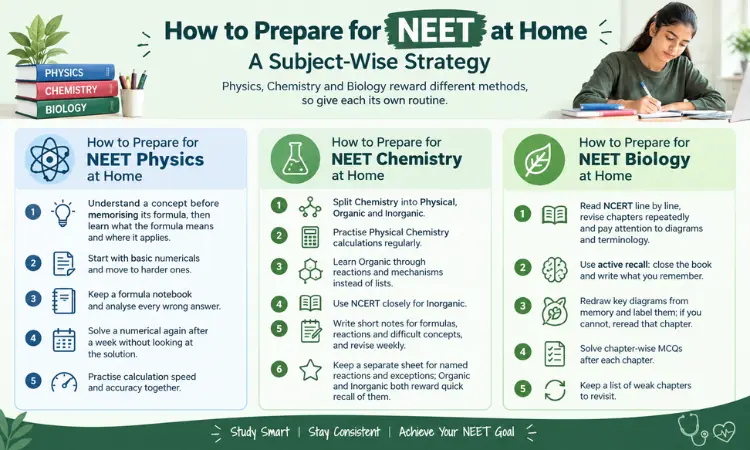
Physics, Chemistry and Biology reward different methods, so give each its own routine.
How to Prepare for NEET Physics at Home
- Understand a concept before memorising its formula, then learn what the formula means and where it applies.
- Start with basic numericals and move to harder ones.
- Keep a formula notebook and analyse every wrong answer.
- Solve a numerical again after a week without looking at the solution.
- Practise calculation speed and accuracy together.
How to Prepare for NEET Chemistry at Home
Split Chemistry into Physical, Organic and Inorganic. Practise Physical Chemistry calculations regularly, learn Organic through reactions and mechanisms instead of lists, and use NCERT closely for Inorganic. Write short notes for formulas, reactions and difficult concepts, and revise weekly instead of waiting for the end. Keep a separate sheet for named reactions and exceptions; Organic and Inorganic both reward quick recall of them.
How to Prepare for NEET Biology at Home
Read NCERT line by line, revise chapters repeatedly and pay attention to diagrams and terminology. Use active recall: close the book and write what you remember. Redraw key diagrams from memory and label them; if you cannot, reread that chapter. Solve chapter-wise MCQs after each chapter and keep a list of weak chapters to revisit.
5. Practise Previous-Year NEET Questions Regularly
Solve previous-year questions (PYQs) after finishing each chapter, to test your understanding of it while the concepts are fresh. They also show which concepts and question styles are tested. Sort them by chapter and keep a short list of the question types that trip you up. Do not memorise answers. For each question, work out why the right option is right and why the others are wrong, record the ones you missed and revisit them during revision. Increase your speed gradually without giving up accuracy.
6. Take NEET Mock Tests and Analyse Your Mistakes
How do mock tests help in NEET preparation? Mock tests help you practise time management, find weak topics, measure accuracy, get used to exam pressure and spot repeated mistakes.
Begin with chapter-wise tests, move to subject-wise tests and then add full-length papers. The 2026 paper was in pen and paper mode, so take full tests on paper where you can, in one three-hour sitting. After each test, track incorrect questions, unattempted questions, time-consuming questions, and whether each error was conceptual, a calculation slip or a guess. Each wrong answer cost a mark in 2026, so the review is where the marks are won. Keep an error notebook and reattempt the questions after revising. Do not judge one test too harshly; look at three or four results together to see the trend.
7. Revise the NEET Syllabus Regularly
Finishing the syllabus once is not enough. Put revision into the weekly timetable: formulas, diagrams, reactions, definitions, important concepts and difficult questions. Short notes speed up quick revision, and active recall works better than rereading. Revise old topics alongside new ones, give weak chapters extra slots and tick off each revised chapter on your checklist. A weekly revision slot plus a longer monthly pass over completed chapters keeps early topics from fading.
8. Use Online Resources Carefully When Preparing at Home
An online lecture can clear a concept that a textbook did not. Pick a few trusted resources and avoid watching several teachers explain the same topic. Do not spend more time searching for resources than studying. Try the question first, then watch the explanation. Take notes on difficult concepts, then return to the textbook and solve two more questions on the same concept. Online lessons should supplement question practice, not replace it.
Self-study does not mean learning everything alone. It means taking responsibility for your preparation and knowing when to seek appropriate guidance.
9. Manage Distractions While Studying at Home
Home gives you flexibility and distractions in equal measure. These NEET preparation tips keep study blocks productive:
- Keep the phone out of reach and cut back on social media.
- Set up a dedicated study space and tell the family your fixed study hours.
- Study in focused sessions with short breaks, and avoid multitasking.
- Keep entertainment separate from study time.
- Check each week whether the planned hours were actually productive.
10. Know When You Need Additional Academic Guidance
Coaching is only one form of guidance. NEET preparation without coaching still goes better with a teacher or mentor to turn to. Look for support when:
- A concept stays unclear after self-study.
- Mock-test performance does not improve.
- You cannot hold a consistent schedule.
- You struggle to identify your weak areas.
- Balancing PUC and NEET becomes difficult.
If you do seek help, ask for specific feedback on your mock-test errors and study plan, not just more lectures. Some students manage well alone and others need structure; neither is a failure. Students who prefer structured NEET and PUC support can look at the 2-year NEET programme at Vibrant in Moodbidri.
11. Common Mistakes to Avoid During NEET Self-Study
The NEET preparation mistakes guide covers the exam-wide list. For home study, watch for these:
- Starting without understanding the syllabus, or with an unrealistic timetable.
- Collecting too many books and watching too many videos.
- Ignoring weak chapters and studying only favourite subjects.
- Delaying revision, or memorising without understanding.
- Taking mock tests without analysing the mistakes.
- Comparing your progress with friends or social media students.
- Ignoring PUC or board studies.
- Heavy phone use and regular loss of sleep.
12. How to Track Your NEET Preparation Progress
Review a simple tracker once a week, then adjust the next week’s plan to match. Read the numbers together: if attempts rise while accuracy falls, slow down and revise; if accuracy is good but scores stay low, check how long each question is taking.
| Area | What to Track |
| Syllabus | Chapters completed |
| Revision | Chapters revised |
| Practice | MCQs and PYQs attempted |
| Accuracy | Correct vs incorrect answers |
| Mock tests | Score and time |
| Mistakes | Repeated errors |
| Weak areas | Topics needing more study |
Sample Daily NEET Self-Study Timetable
| Time | Activity |
| Morning | Biology NCERT reading or revision |
| Morning | Physics concept learning |
| Midday | Chemistry concepts and question practice |
| Afternoon | Break, then PUC or academic work |
| Evening | Biology MCQs and PYQs |
| Evening | Physics and Chemistry question practice |
| Night | Revision and error notebook |
This is only a sample. Adjust it to your school or PUC schedule, your preparation level and your strengths. For a broader routine, see the study time table for science students.
Start Small and Stay Consistent
Knowing how to prepare for NEET at home is mostly a question of order and consistency. Understand the syllabus, plan realistically, build on NCERT, give each subject its own method, practise questions, analyse mock tests, revise on schedule, limit distractions and ask for help when a problem stays unsolved. Keep your routine sustainable, with enough sleep. No method can promise a particular score, rank or medical seat, but a structured routine gives you feedback you can act on.
| Want Structured NEET Support Alongside PUC? Vibrant PU College in Moodbidri offers a 2-year integrated NEET programme with PUC. Call +91 7411417028, email info@vibrantpucollege.com or see the course details to find out whether it suits your preparation. |
Frequently Asked Questions
1. Can I crack NEET without coaching?
Preparing for NEET at home is possible, but no method can promise a score, rank or seat. It works when you follow the current NTA syllabus, build on NCERT, practise questions daily, take timed mock tests and analyse your mistakes. Seek a teacher’s help whenever a concept stays unclear.
2. How many hours should I study daily for NEET at home?
There is no single number that suits every student. Productive hours matter more than total hours: a fixed block for each subject, regular question practice and a weekly review of what actually went well. Balance NEET time with your PUC or school work instead of copying someone else’s schedule.
3. Is NCERT enough for NEET preparation?
NCERT is the core text and should be read more than once, especially for Biology. Reading alone does not build exam skill, so add previous-year questions, chapter-wise MCQs and mock tests. Bring in an extra book only to fill a specific gap, and finish it before adding another.
4. How many mock tests should I take before NEET?
There is no fixed count. Start with chapter-wise tests, move to subject-wise tests and then add full-length papers under timed conditions. Reviewing each test matters more than the number you take, so keep an error notebook and reattempt the questions you got wrong.
5. What is the NEET (UG) exam pattern?
According to the NTA’s NEET (UG) 2026 Information Bulletin, the paper has 180 multiple-choice questions for 720 marks: Physics 45, Chemistry 45 and Biology 90. The exam is three hours long in pen and paper mode, with 4 marks for a correct answer and minus 1 for a wrong one. Check the current year’s bulletin for any change.
About the Author
Subhash Jha is the CEO of Vibrant Academy for Innovative Learning (VAIL), which runs Vibrant PU College in Moodbidri. He leads the institution’s integrated PUC and NEET/JEE preparation programme, working with the academic team on curriculum structure, guided study sessions and student academic support.
Reviewed By
L K Monu Borkala is Chief Strategist at OneCity Technologies, a digital marketing strategist with 20+ years of SEO experience and over 650 client campaigns across India and UAE. This review covers content accuracy, tone and editorial standards.